
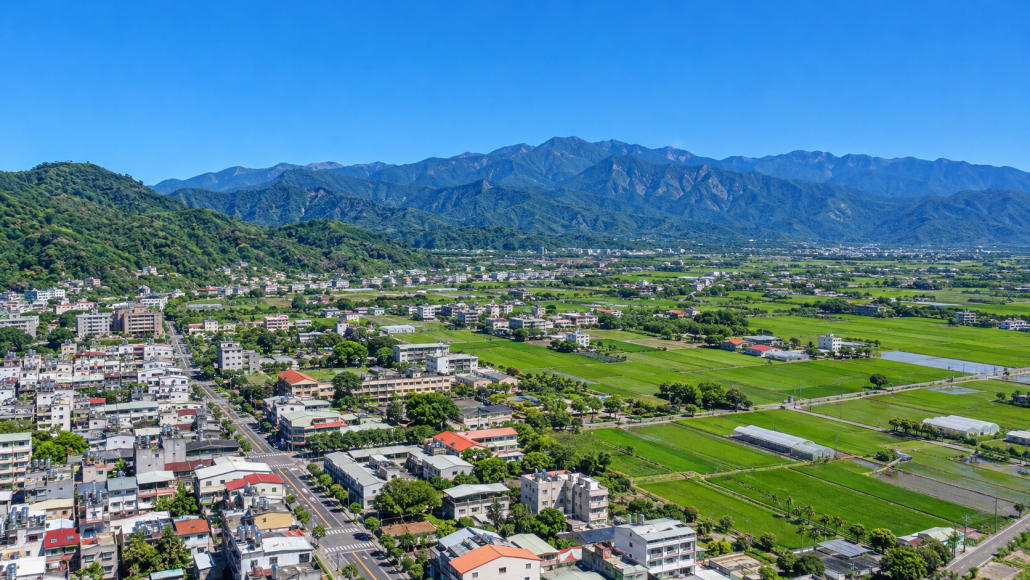
Why can air quality worsen in Taiwan during autumn and winter, even under blue skies? Monsoon winds, mountain barriers, rainfall and pollution emissions create different conditions across the island. This guide brings together official PM2.5 statistics and public-health guidance to help readers understand seasonal changes and make informed decisions at home and outdoors.
The featured landscape is an AI-generated illustration, not an observation of air quality at a particular location or date.
Key takeaways
- Autumn and winter air quality depends on weather, terrain, local emissions and transported pollution; conditions are not uniformly poor across Taiwan.
- A lower national annual PM2.5 average does not mean lower exposure in every season, city or day.
- Check local AQI readings and combine pollution-source control, appropriate ventilation and air filtration.
Compiled by the TYVOX editorial team. Updated November 3, 2026. This article provides general environmental and health information, not individual medical advice. Cited agencies do not endorse TYVOX products.
1. Taiwan’s PM2.5 trend: improvement does not eliminate daily pollution events
Official Ministry of Environment data show an overall decline in Taiwan’s national annual mean PM2.5 concentration in recent years, but not a continuous decrease every year.
| Year | Annual mean PM2.5 |
|---|---|
| 2019 | 16.2 μg/m³ |
| 2020 | 14.1 μg/m³ |
| 2021 | 14.4 μg/m³ |
| 2022 | 12.4 μg/m³ |
| 2023 | 13.7 μg/m³ |
| 2024 | 12.8 μg/m³ |
| 2025 | 12.8 μg/m³ |
The 2019–2024 figures come from the Ministry’s published report; the 2025 figure is its currently published manual-monitoring-station statistic. These are national annual averages, not autumn–winter averages or measurements of individual exposure. Sources: Ministry of Environment historical report (Chinese) and Air Quality Management.
Long-term improvement and seasonal pollution episodes can coexist. For daily decisions, use monitoring and forecasts for your location rather than relying on a nationwide yearly figure.
2. How northeast monsoon winds and Taiwan’s mountains affect air quality
The Central Weather Administration explains that the northeast monsoon becomes established in autumn. Northern and northeastern Taiwan receive more windward rainfall, while the Central Mountain Range blocks northeast winds from reaching the southwest as readily. Southwestern Taiwan consequently enters its dry season. The same weather system can therefore bring very different wind and rainfall conditions to different regions. Source: Central Weather Administration: autumn climate (Chinese).
According to the Ministry of Environment, central Taiwan and the Yunlin–Chiayi–Tainan region can experience weak winds and poor dispersion on the leeward side of the mountains during certain high-pressure return-flow patterns. Sea and land breezes can also move pollutants between coastal and inland areas, allowing them to accumulate. Northern Taiwan is not always protected: winter transport from outside Taiwan and weak winds within basins can also affect air quality. Source: Ministry of Environment: regional air-quality patterns in western Taiwan (Chinese).
Seasonal air pollution cannot be attributed solely to overseas sources. Local emissions, wind direction and terrain must be considered together.
3. A lower winter mixing layer can trap pollution near the ground
Vertical air movement matters as well as horizontal wind. Kaohsiung’s Environmental Protection Bureau explains that Taiwan’s average atmospheric mixing layer is lower in winter, making it easier for pollutants to accumulate near the surface. Northeast winds and the blocking effect of the Central Mountain Range can jointly produce unfavorable dispersion conditions in the Kaohsiung–Pingtung region. Source: Kaohsiung Environmental Protection Bureau: seasonal air quality (Chinese).
This helps explain why a dry, settled day may not deliver clean air. Comfortable temperatures and low pollution concentrations are different things.
4. Health effects extend beyond the respiratory system
The World Health Organization estimates that outdoor air pollution caused approximately 4.2 million premature deaths worldwide in 2019. About 68% were attributed to ischemic heart disease and stroke. These are global burden-of-disease estimates, not Taiwan-specific death counts. They highlight that air pollution is a long-term cardiovascular and respiratory health issue, not merely a cause of temporary throat irritation. Source: WHO: ambient air pollution and health.
Taiwan’s Health Promotion Administration identifies air pollution and sudden temperature changes as asthma triggers. Wheezing, chest tightness or a persistent cough should not automatically be dismissed as a seasonal nuisance; seek appropriate medical assessment. Source: Health Promotion Administration: chronic respiratory diseases (Chinese).
5. Practical protection outdoors and indoors
Check your local Air Quality Index (AQI) before outdoor activities. Taiwan’s Health Promotion Administration notes that AQI 101–150 is an orange alert, unfavorable for sensitive groups including children, older adults and people with heart or lung conditions. AQI 151–200 is a red alert, with potential health effects for everyone. Adjust activity duration and intensity according to official advice. Source: Health Promotion Administration: air-pollution precautions (Chinese).
For indoor air, combine source control, appropriate ventilation and filtration. The U.S. Environmental Protection Agency recommends reducing pollution sources and ventilating with clean outdoor air. Air cleaners can supplement these measures, but cannot remove every pollutant or replace ventilation and source control. Source: U.S. EPA: air cleaners and air filters in the home.
Frequently asked questions
Is Taiwan’s air quality always worse in autumn and winter?
No. Winds, rainfall, terrain and emissions vary by region and day. Some leeward areas in central and southern Taiwan are more prone to pollution accumulation, but local AQI readings remain more useful than a season-wide assumption.
Does a clear blue sky mean the air is clean?
No. Sky appearance and visibility do not replace measurements of PM2.5 and other pollutants. Check official monitoring and forecasts before planning activities.
Can an air purifier replace ventilation?
No. Air purifiers are supplementary tools and cannot remove all pollutants. Source control and appropriate ventilation remain important; consider outdoor air quality when deciding when to ventilate.
Make seasonal air-quality decisions with evidence
Taiwan’s long-term air-quality improvement is encouraging, but monsoons, mountains and daily weather still create regional differences. TYVOX encourages readers to check monitoring data, reduce indoor pollution sources and maintain their indoor environment throughout the season, rather than acting only when visible haze appears.
Related product information: TYVOX MINI Air Purifier. Refer to the product page and applicable test documentation for specifications and operating conditions.


